Search Results
279 results found with an empty search
- “The Weaponization of Loneliness: The Tyrant’s Choice for Control,” Episode 218 of Economic War Room
The Weaponization of Loneliness: The Tyrant’s Choice for Control,” Episode 218 of Economic War Room
- “The Right Take” with Mark Tapson, Horowitz Freedom Center, “The Weaponization of Loneliness” featuring Stella Morabito -- December 12, 2022
Mark Tapson The Weaponization of Loneliness
- Interviews on my book, The Weaponization of Loneliness
I've probably done more than 50 interviews so far about my book The Weaponization of Loneliness, often on talk radio as well as on podcasts, and some TV. Each one has been gratifying and all so different. I will post more of them to this blog, though in no particular order. For example, even though the subject matter is so serious, this interview with Michael Savage posted on December 6 was so much fun. He's very engaging and doesn't mince words. It's no wonder he's been cancelled in the past and considered so controversial! He loves real conversation -- and it shows. The intro begins at about 4:08 below, and the actual interview begins at about 7:50. Interviews on my book, The Weaponization of Loneliness
- Sebastian Gorka and I discuss The Weaponization of Loneliness
I recently sat down with Sebastian Gorka in-studio and had a great conversation about how--and why--so much insanity has taken root in this country. I believe the bottom line is decades of self-censorship. For too long Americans have been obedient to political correctness, fearful of ostracism they might experience if they simply speak their minds. This gives an enormous amount of oxygen to bad agendas and to institutional subversion. If we hope to revive civil society, we have to become more aware of these dynamics. I really loved talking about my book with Sebastian Gorka. He is such a wonderful and engaging host. He brings the valuable perspective of an immigrant who truly appreciates America and the freedom endowed to us by the U.S. Constitution. Sebastian Gorka Weaponization of Loneliness
- STELLA MORABITO - THE WEAPONIZATION OF LONELINESS
STELLA STELLA MORABITO - THE WEAPONIZATION OF LONELINESS
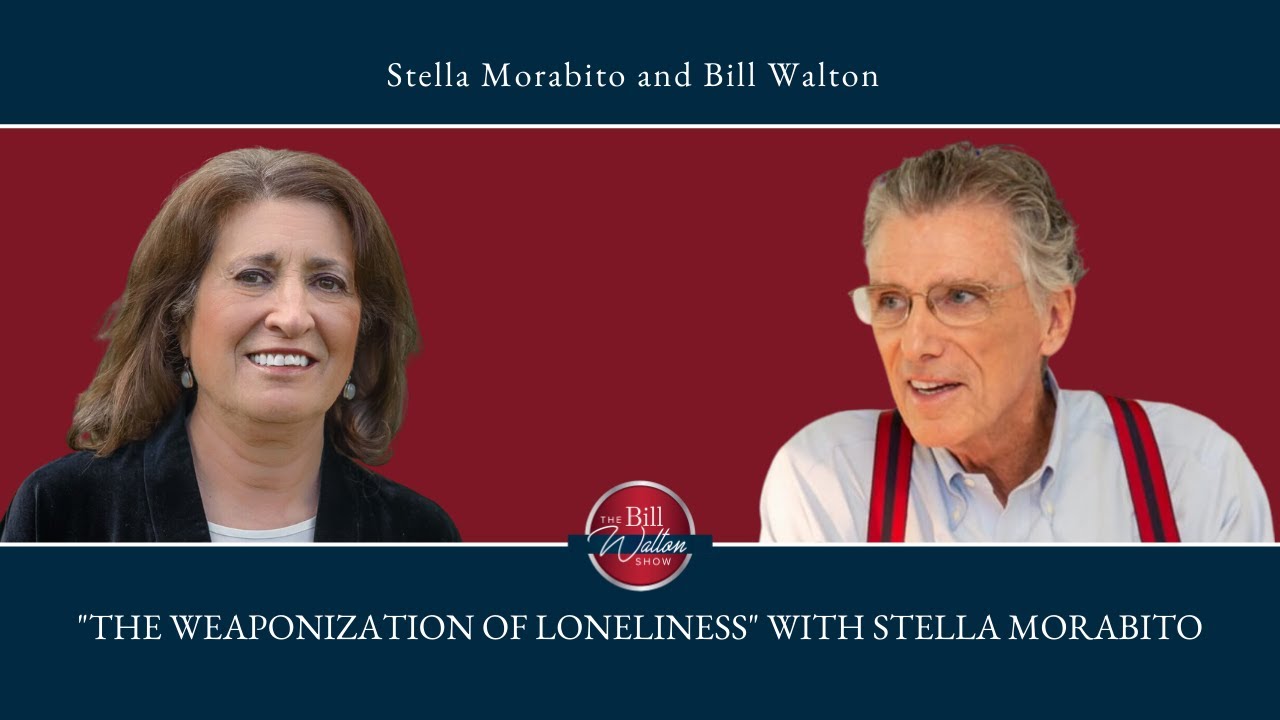
- The Bill Walton Show. Episode 226: The Weaponization of Loneliness,” with Bill and Sarah Walton
Weaponization of Loneliness Bill Walton Show
- New Interview on The Weaponization of Loneliness -- with Bill Walton
I love The Bill Walton Show. He and his wife Sarah are so insightful and interesting. They keep important conversations going, bringing light into the chaos of our times. I recommend you subscribe to Bill's Youtube channel if you're looking for in-depth discussions of the most critical issues of the day. Bill has interviewed many prominent thinkers, including George Gilder, Naomi Wolf, Arthur Laffer, James Lindsay, and Winsome Sears--to name a very few. So I was honored to return to Bill's show, this time for an in-depth conversation about my book The Weaponization of Loneliness. You can watch the discussion below: We talked about the uses of isolation as a political weapon today, as well as throughout modern history. I'm actually amazed at the many points we covered in one short hour, though there was a lot more we could have said on this topic. My hope is that more Americans become conversant with the dynamics that lead to our self-censorship so that we can overcome that fear of ostracism and start speaking out. Because self-censorship gives a lot of oxygen to destructive agendas. Worse, it opens the door wide for far more punitive forms of top-down censorship. Bill and I ended on a hopeful note. There is so much even one person can do to overcome the darkness and chaos that surrounds us today. Just one honest conversation with another person can open the door to new ideas and influences that that strengthen civil society. This causes the sort of ripple effect of freedom that tyrants always seek to squash through censorship. We talked about the revival of beauty in the public square. And the revival of comedy! We talked about my book club project on the topic of the Weaponization of Loneliness, and we discussed all of the parallel polises springing up. Please give our conversation a look and a listen! And please subscribe to Bill Walton's wonderful podcast! The Weaponization of Loneliness -- with Bill Walton
- The Exploitation - and Weaponization - of Loneliness: Now the Feds say they plan to "solve" our L...
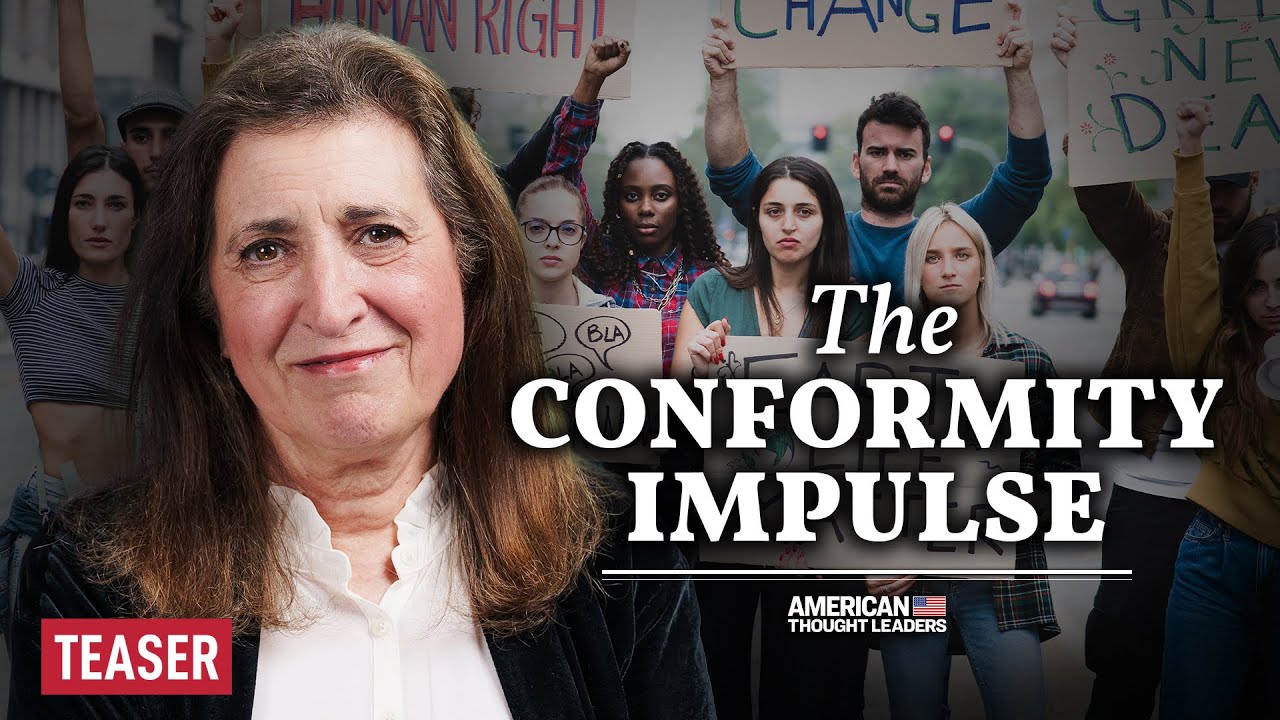
I recently had the honor of being interviewed by Jan Jekielek for his Epoch Times program “American Thought Leaders.” Epoch Times posted it on Twitter and here, along with a transcript: Stella Morabito: Technocratic Totalitarianism, the Impulse to Conform, and Astroturfed Mobs versus Organic Protest You can view the preview here: Jan and I talked at length about the subject of my book, The Weaponization of Loneliness. We covered a lot of ground on the human fear of social rejection and how it causes people to shut up --and even lie -- about what they believe. The consequences are massive because mass self-censorship always gives a lot of oxygen to destructive agendas. What are the dynamics involved in that? We discussed them in the context of conformity impulse, political correctness, identity politics, public opinion polling, mob formation, and how power elites build the illusion of consensus, even when there is no consensus. Ultimately, this is all ramping up to be a war on the private sphere of life: family, faith, true community, and friendship. Those are the only institutions that give us the strength to resist totalitarian designs. This is evident now that Senator Chris Murphy (D-CT) recently introduced legislation called “The National Strategy for Social Connection Act.” The bill is a follow up to the surgeon general’s advisory on “Our Epidemic of Loneliness and Social Isolation.” It's ironic because government policies--particularly those that promote family breakdown, addiction, urban blight, dependency, and more--are largely responsible for the loneliness epidemic in the first place! As I wrote in the Federalist, both the advisory and the legislation read like a blueprint for government takeover of the private sphere of life. My latest article on that is here: “Beware of Bureaucrats Wanting to be your BFF.” The Exploitation - and Weaponization - of Loneliness
- Hillary Clinton and "The Weaponization of Loneliness"
I was dismayed, though not hugely surprised, when I saw Hillary Clinton’s recent article at the Atlantic headlined with the exact title of my book, The Weaponization of Loneliness. You can read further about my reaction in this Federalist article, “Yes, Hillary Clinton is a Big Fan of ‘The Weaponization of Loneliness.’” One purpose of Clinton’s Atlantic article is to promote Surgeon General Vivek Murthy's recent advisory on the loneliness epidemic, which, as I've written, serves as a blueprint for government invasion of the private sphere of life. As author of the 1996 book It Takes a Village –a soft treatise on collectivism--Clinton also presents herself as a forerunner to the advisory. But another purpose is to set up a propagandistic narrative that positions her political opponents as the only folks who create and exploit social isolation. It co-opts the term "the weaponization of loneliness" to try to do that. Was Clinton's headline a coincidence, or made up on the fly by an editor? Highly unlikely. A major publication must carefully consider how to title a 3500-word article with Hillary Clinton's byline. My book has been out since October, and its title has been circulated publicly in hundreds of interviews, op-eds, articles, and reviews, all related to my book's thesis about social isolation as a political weapon. In fact, when I first considered the title and googled it several years ago, I couldn’t find it anywhere in print. Numerous interviewers and podcasters have remarked on how unique and compelling a title it is. So it certainly seems like an effort to co-opt the term and associate it with a high profile public figure on the political Left instead of as the thesis of a lesser known author such as myself. If Hillary Clinton has a thesis for “the weaponization of loneliness” (which she does not) it is 180 degrees apart from mine. I focus on social processes and human impulses and agendas in which weaponized loneliness--and especially the fear of isolation--it is modelled throughout modern history. Clinton's Atlantic article rails against all things “right wing” and then places the blame for our society’s alienation on what she once termed “a vast right-wing conspiracy," featuring villains such as Newt Gingrich, Steve Bannon, “incels,” and Rush Limbaugh. Hence, Clinton's essay is not an exploration of the process of isolation as a political weapon. Rather, it seems intended to distract from many of her pet policies and programs that actually cultivate loneliness by building dependency on government as well as censoring and demonizing anyone with different ideas. Many of those policies have actually resulted in social fracturing and despair, including family breakdown, urban blight, addictions, attacks on free speech, and now the transing of children. Clinton's Atlantic piece is meant to bury all of that and shift blame. Ultimately, if the invasive programs and policies of the surgeon general's loneliness advisory are enacted, we are bound to see far more atomization and misery, not less.
- Stella Morabito, The Weaponization of Loneliness, Richard Vague, The Paradox of Debt, Rhus Tox, NM G
Stella Morabito The Weaponization of Loneliness
- Introducing Stella's Book Club on the Weaponization of Loneliness
Welcome to my new website www.stellasbookclub.com! The central theme is the subject of my book The Weaponization of Loneliness. I hope this website can be a place to better understand how tyrants use the natural human fear of isolation to silence us in order to to control our speech, our relationships, and our thoughts. This is key to understanding how propaganda works. I believe such knowledge is critical to reviving civil society and freedom. So I came up with the idea of book clubs as a way for people to break out of their isolation and speak openly about the weaponization of loneliness in friendly groups. I hope these circles of trust and learning can help more of us take a clinical look at the process of the weaponization of loneliness. We can then learn to detect that process wherever we go, while building the inner strength to resist it. We cultivate a spirit of camaraderie when we share our observations and exchange ideas on the subject. A good discussion group can assure us we are not alone in our fears, nor in our hopes for real freedom. "Knowledge is Power." Thomas Jefferson's Bookcase at Monticello (Wikimedia Commons) This new website will also be a clearinghouse for most of my work, many of my interviews, and the essays that I've published through the years, including those on my previous blog site. To get an idea of the materials the book club will cover, take a look at the bibliography on this website. It's multi-media, which means I will be supplementing the book selections with other materials, such as articles and clips from documentaries and movies. Stella's Book Club is structured so that we first get familiar with the thesis by looking at all of the elements in my book The Weaponization of Loneliness: How Tyrants Stoke Our Fear of Isolation to Silence, Divide, and Conquer. I recommend four sessions because there is so much material to cover. If you're ambitious, you can condense it to fewer sessions. Try to allow time to absorb the materials. Guides with study questions for each session will be posted to my book club website. Starting with the fifth session (or third or fourth if you decided to condense) I'll draw from titles in the select bibliography you can find on the website. So the "Fifth Session" will be designated as the first to draw from other works related to the thesis of The Weaponization of Loneliness, beginning with the must-read classic, The Rape of the Mind by Joost Meerloo. You can start a book club of your own on this topic, using the portal on my website to contact other members of your club with comments and questions and to arrange for your meetings. I hope you'll start or join a book club of your own. And I hope you'll subscribe to this website! Welcome! Weaponization of Loneliness Stella's Book Club
- State Censorship leads to our isolation
My piece today at The Federalist explains that censorship is all about cutting you off from other people. Because if you can speak openly to others, you become isolated from them. As I explain in my book, as more people self-censor out of fear of social rejection, the more atomized we become. It's a great irony that I call the weaponization of loneliness. This sets the stage for government regulation of personal relationships. I explain how in my article at this link: https://thefederalist.com/2024/04/05/murthy-v-missouri-is-not-just-about-coercing-big-tech-but-controling-individuals/ That's what's at stake in the Supreme Court case Murthy v. Missouri. Here's an excerpt: Too few people understand that the primary purpose and the main effect of political censorship is intensely personal, a point I’ve explained before here at The Federalist. In addition to cutting us off from other people and ideas, censorship instills fear of punishment for wrong think. As more people fear speaking openly, we create a spiral of silence that isolates us further. This dilutes personal relationships along with the potential for building relationships and breeds a more alienated and dysfunctional society. Free speech is how people get to know one another, building social trust and a healthy private sphere. It’s how we are able to solve problems through the cross-pollination of ideas. It’s the first line of defense against tyranny. A Supreme Court ruling for the government in the Murthy case would be an anti First Amendment move, which means anti-conversation and anti-friendship. It would open the door for a full-fledged attack on the private sphere of life.